
Investing Effectively Using the 80-20 Principle
Friday, July 19, 2024
Prefer to watch instead? Scroll down for the video version!
Time is valuable, and with a full-time job, you should not spend too much time on your finances.
That’s where the Pareto Principle comes in and how we can use it for our investments.
The Pareto Principle, also known as the 80-20 Principle, states that 80% of the results come from 20% of the effort we put into something. Meaning when we can identify what the 20% of effort is, we can save energy and time and still get 80% of the results.
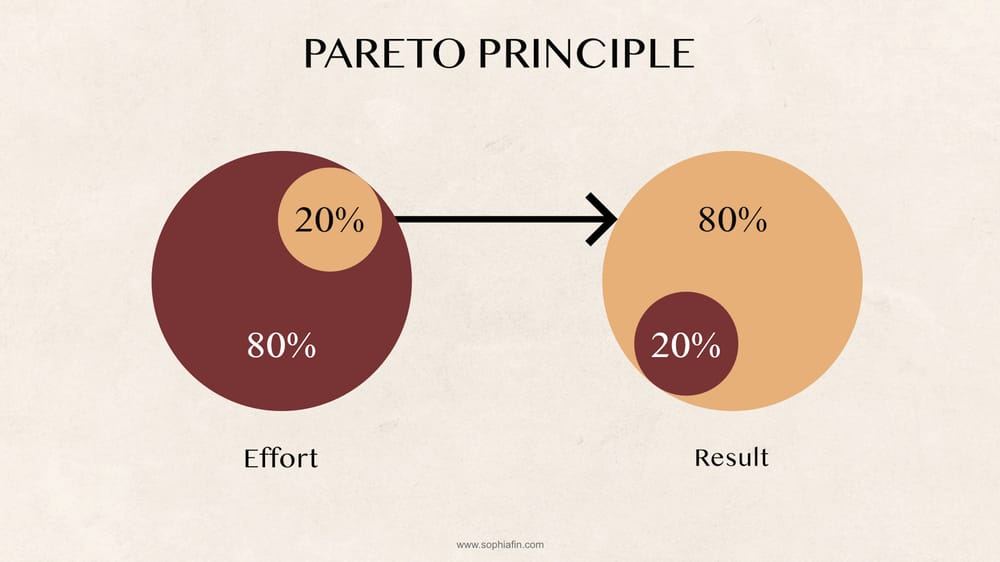
Let’s talk about three areas where we can apply the 80-20 principle when it comes to investing our money:
1. Investment Products
2. Asset Allocation and Risk Tolerance
3. Investment Strategy
1 - The Pareto Principle for Investment Products
There are a ton of different products to invest in out there - stocks, bonds, crypto, NFTs, art, collectibles, derivatives, options…
We want to pick the 20% of investment products with a decent return and a good risk profile. For those requirements looking into history what has the highest potential for growth is our best bet.
Assets that check that box are stocks, bonds, real estate and commodities. They all of been around for hundreds of years and overall stocks have the best track record of long-term growth.
That doesn’t mean you cannot also play around with (crypto-) currencies or other types of investments. They just shouldn’t be the larger part of your portfolio if you want to keep the effort to a minimum.
2 - The Pareto Principle for Asset Allocation and Risk Tolerance
Now that we have established the 20% of products or assets, we have to determine which ones and how much to put into our portfolio.
These questions will be answered by our risk tolerance. The three main factors that determine our risk tolerance are time horizon, financial goals, and how you deal with risk.
To condense it down to the 20% of effort, I suggest the following figure:
Time Horizon
More than 20 years = high risk
Less than 10 years = low risk
Financial Goals
Building wealth = high risk
Preserving wealth = low risk
How you personally deal with risk
Seeing red numbers is okay = high risk
Seeing red numbers freaks me out = low risk
I don’t know → start small, then level up
I personally end up at “high risk” in all three factors; that’s why I have 90% stocks in my portfolio, with the rest in cash.
Quick reminder: asset allocation is the way you allocate different assets in your portfolio.
So, based on your result on what risk tolerance suits you best, you can start planning your asset allocation.
3 - The Pareto Principle for Investment Strategy
After deciding what assets and in what quantity to put in your portfolio, we get to the specific investment strategy for each asset.
This will also be the moment where we can go one level deeper into the 80-20 principle.
Let’s take, for example, stocks:
We could pick single stocks. That would take time and effort to research the individual companies (unless we pick them just based on our gut, but then we increase the risk even more).
Or we could pick a fund, where several companies from different sectors and countries are already bundled together. This way, we lower the risk by diversification.
Let’s look at real estate as another example:
We could buy a property as an investment for ourselves. That would again require research and also a high amount of capital.
Alternatively, we could go for a REIT, a real estate investment trust. This means buying shares from a company that invests in different real estate properties. That way we still invest in real estate, but save time and effort.
Another way to look at this is when it comes to investment strategies in general.
You will find hundreds of thousands of books about investment advice out there, and it can be hard to know who to trust.
We can pick the books from very successful investors whose investment strategies have already been proven to work. That’s what I did.
Last but not least, we should always look at costs too. So focus on the investment opportunities with the lowest costs.
🧡 My Favourite Things
🎬 YouTube Video - I discovered this video on YouTube where Mel Robbins explains how important visualization is for reaching your goals (research-backed).
✍🏻 Quote of the Week
“Your smile is a messenger of your good will. Your smile brightens the lives of all who see it. To someone who has seen a dozen people frown, scowl or turn their faces away, your smile is like the sun breaking through the clouds.”
How to win friends and influence people by Dale Carnegie
Watch the video version here!

Hi, I'm Sophia
I’m a doctor turned wealth enthusiast, helping high-achievers build financial freedom—without giving up the luxuries they love. On this blog, I share strategies to fast-track your financial journey and grow lasting wealth.
PAGES
OFFERS

© 2025 Sophia Fin. All Rights Reserved. Privacy Policy Cookie Policy Terms & Conditions
DISCLAIMER: I am not a licensed financial advisor. All the information found on this website is for educational purposes only and does not consitute financial, tax or insurance advice.